
There are plenty of places to hear new ideas about training. What's harder to find is a place where those ideas get tested against how teams are actually operating. That's the role the LTEN annual conference tends to play.
On paper, it brings together life sciences learning and development professionals for several days of workshops, labs, and networking. In practice, it functions more like a working session for an industry trying to figure out how to turn learning into something measurable and repeatable.
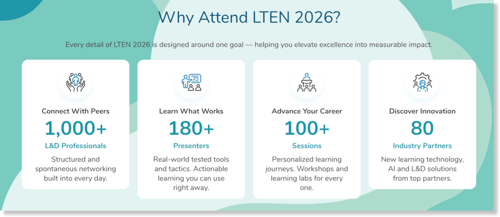 This year's conference runs June 15-18 at the Gaylord Palms in Kissimmee, Florida, with more than 70 workshops, 30-plus learning labs, and over a thousand attendees from pharmaceutical, biotech, medical device, and diagnostics companies.
The numbers are impressive, but the value is in the conversations. When that many people responsible for field training and performance are in the same room, the gaps between what's assumed and what's actually working become hard to ignore.
Clarity Over New Ideas
LTEN tends to surface the operational realities that don't make it into strategy decks. When you spend time in those conversations, patterns emerge
- Leaders developing experienced teams that no longer respond to generic coaching approaches
- Organizations that have invested heavily in tools but are still working to define what good execution actually looks like
- Teams measuring what is easiest to track, while quietly questioning whether those metrics reflect any real progress in the field
These aren't hypothetical scenarios. They come up repeatedly because they reflect the day-to-day friction most organizations are navigating right now. Seeing them side by side is what makes the conference useful. It gives you a reference point for where your own approach is working and where it might need a second look.
Coaching Carries More Weight Now
The expectations placed on coaching have changed. Coaching is still part of the manager’s role, but now it is also being asked to improve performance, develop talent, create consistency, and show measurable impact.
That is where many organizations get stuck. They know coaching matters, but they do not always have a clear way to define what effective coaching looks like, measure whether it is happening, or understand which behaviors are making the biggest difference.
That is the focus of Echelon’s co-hosted LTEN 2026 workshop, "The Missing Metric: Why Coaching Belongs at the Center of Commercial Learning Strategy."
The workshop will take place on June 16 at 3:30 PM. It will feature Ed McCarthy, Echelon Founder/CEO, Ted Power, iCoachFirst GM Field Enablement, and Dan Listemann, Botanix VP/Marketing Operations. Together, they will look at how organizations can move past vague coaching activity and start treating coaching as a measurable, strategic part of commercial learning.

The premise is straightforward. Coaching is a core driver of commercial strategy, not a peripheral support function. It is where strategy is translated into action in the field. Organizations that treat coaching as a measurable discipline see faster, more sustainable results.
The session will explore why coaching quality belongs in the same strategic conversations as revenue metrics, market share, and sales productivity. It will also examine how organizations can measure coaching effectiveness and use technology, including AI, to make coaching more consistent, repeatable, and scalable.
Drawing on practical examples and field coaching data, the speakers will show how coaching can move from a routine activity to something more deliberate and strategically aligned with commercial performance.
Participants will come away with a clearer understanding of how to define coaching quality in practical terms, how to use technology in a way that supports rather than distracts from the work, and how to focus managers on the behaviors most likely to lead to measurable improvement.
Why This Sticks
What makes LTEN useful is not that it presents entirely new ideas, but that it creates the conditions for honest evaluation of the ones already in place. When you see how other organizations are approaching the same challenges, it becomes easier to identify where your own approach is effective and where it may be falling short.
In most cases, what people take away is not a completely new strategy, but a more precise understanding of where to focus and what needs to change. The thinking becomes less broad and more specific, which is often what leads to better decisions once they return to their teams.
For anyone responsible for training, coaching, or field performance, that level of specificity is where the real value tends to sit.
To ensure you connect with the Echelon team at LTEN, you can schedule a meeting at the show HERE.