

Before there was a company, there was a rep.
She was Ed's best. Hitting every number, exceeding every target, the kind of salesperson a manager thanks their lucky stars for. And because she was so self-sufficient, so clearly fine, Ed left her alone. He focused his energy on the people who needed help.
She resigned.
Not because the job was wrong or the money was bad. Because her manager, a good manager, an attentive one, someone who genuinely cared about his team, had never once invested in developing her. Had never sat down and asked: what do you need to get even better? She was excellent, so she was invisible.
Ed has never forgotten that. It's not why he started Echelon Performance, but twenty years in, it's still one of the clearest explanations for why the work matters.
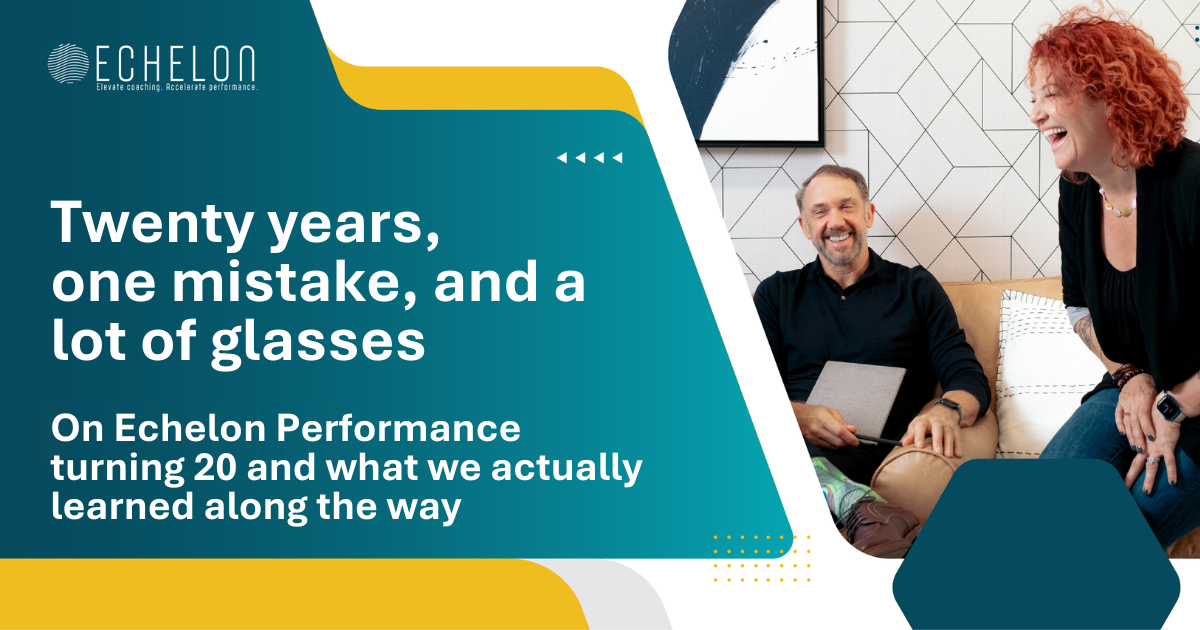
Twenty years ago this April, we started a company. The original idea was a sales training framework for oncology teams - a way of helping reps navigate the genuinely complex reality of how treatment decisions get made in healthcare settings. It worked so well that another company bought it.
Most people would have taken the win and gone home.
We kept going. Because the question that actually wouldn't leave us alone wasn't about training. It was about coaching. Specifically: what is actually happening when a manager sits down with a rep in the field? Not what they report. Not what the 360 survey says. What is actually happening?
Answering that question turned out to require reading a very large number of coaching reports.
The Cool Glasses Club
Here's something nobody tells you when you start a coaching analytics company: you will read a lot of documents.
Ed started by reading field coaching reports manually. Observations recorded by hand. Patterns tracked in spreadsheets. It was slow, painstaking, and, it turned out, genuinely revelatory. Coaching behaviors could be observed, categorized, and improved with far more precision than most organizations had ever tried.
Then in 2016, everything changed.
Claire Davids joined Echelon after twenty years of building and ultimately selling her own business. She didn't need a new project. She chose this one because she saw exactly where she could make a difference. And that difference was the engine.
Claire is, by her own admission, a systems person. If something is being done, there is a way to do it better, and she will find it. As COO, she took what had been a manual, painstaking process and rebuilt it from the ground up, automating the analysis, scaling capacity, and turning a one-person-and-a-spreadsheet operation into one capable of delivering real, detailed insights to organizations across the industry. All of this before "AI" became something everyone put in their pitch deck.
The team grew. The insights deepened.
And gradually, the analysts started needing glasses.
We now have an unofficial internal membership we call the Cool Glasses Club. Initiation is involuntary. The optometrist is thriving.
The offices (a brief, painful history)
We have not always been lucky with real estate.
Our first office looked out over a quarry, several car dealerships, a bank, and, genuinely and delightfully, a red-tailed hawk that built a nest outside the window.
The second was on the second floor of a physician's building. One room had previously housed an X-ray machine. We called it the Glow in the Dark Room. Visitors were steered past it quickly. We did not linger.
Eventually we landed in Asbury Park, a city we loved, in an office that was later condemned. The move happened during a winter snow squall. No movers were hired. Desks, chairs, and computers were carried through slushy streets by family members, including three teenage sons who we are fairly certain have not forgiven us. They definitely have not forgotten.
What the work does to you
Neither of us came into this expecting coaching to become personal.
Ed's entry point was that moment of clarity with a rep he'd let down, a mistake that turned into a mission. Claire's was different. Twenty years of running her own business, managing her own teams, making her own calls. It wasn't until she was deep in this work that she sat with a thought she couldn't shake: I wish I'd been coached. And I wish I'd coached my own people better when I had the chance.
That's not a talking point. It's something that stays with you.
The work she helped build at Echelon, the automation, the scale, the systems that turned analysis into something clients could actually act on in the field, she sees all of it differently now, because she understands what's at stake in that conversation between a manager and a rep. She's lived it from both sides. So has Ed.
That's the thing about spending twenty years studying coaching. Eventually it changes you.
What twenty years actually looks like
It looks like workshops in China, where Ed facilitated a session with fifty field sales leaders from a dozen countries, standing, at six-foot-four, considerably taller than most of the room.
It looks like a leadership rollout in Amsterdam where a fire alarm cleared the building mid-session, and the hotel, deeply apologetic, treated sixty jet-lagged managers to an unplanned afternoon glass of champagne. They were the sleepiest group ever to reconvene for a debrief.
It looks like two analysts, Margie and Suzy, who joined in 2018, spent years collaborating remotely, and finally met in person for the first time late last year. Eight years of shared work. One lunch.
It looks like clients who tell us they've changed how they run their entire field coaching programs because of what the analysis showed them. Managers who became better leaders. Reps who finally got the development they deserved.
Twenty years in, the question is still the same one that started all of this.
What is actually happening in that conversation?
We think it's still the most important question in performance development. We think most organizations are still not asking it carefully enough.
We're grateful to every client, partner, and colleague who has been part of this work. And we're nowhere near done.
Here's to the next 20!
.png?width=600&height=315&name=Echelon%20Blog%20Posts(2).png)