

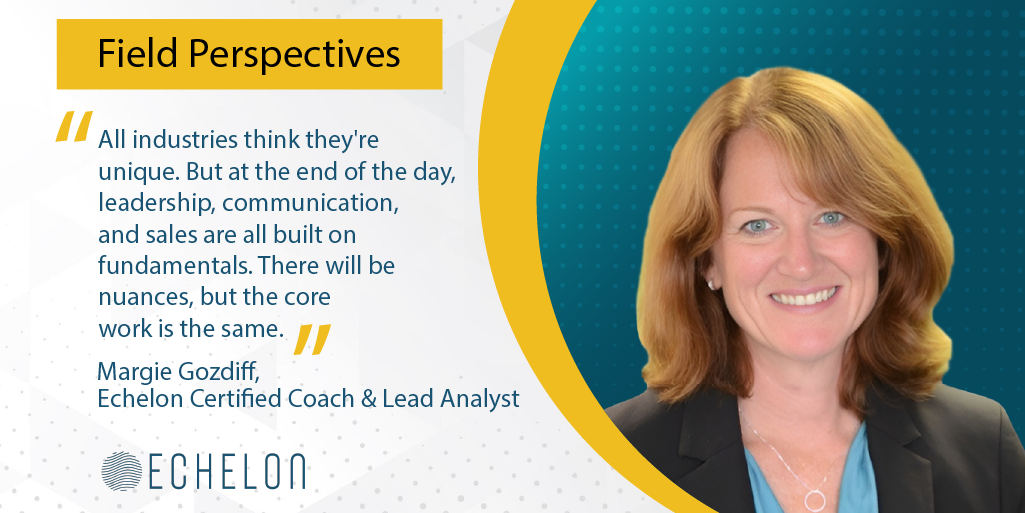
Margie Gozdiff has spent more than three decades helping leaders get better at the thing most of them were never formally taught: developing other people.
The pattern she sees everywhere, from financial services to insurance to life sciences, is the same: managers get promoted because they were great at their jobs, and then nobody teaches them how to develop the people around them.
That gap is where Margie works. And it's what makes her one of Echelon Performance's most trusted coaches and lead analysts.
It Started with a Realization, Not a Plan
Margie didn't set out to become a leadership coach. She started in financial services sales and eventually landed at an insurance company in Boston, where she was pulled into sales training and manager development.
Then something shifted. The organization brought in a third-party firm to train on soft skills: listening, asking questions, building rapport, navigating difficult conversations. It wasn't technical. It wasn't product knowledge. It was the human layer of leadership that most programs skip over entirely.
Margie was trained to deliver that content internally, and the experience changed her trajectory. Not because the material was revolutionary, but because she recognized something in herself: this was the work she wanted to do.
From there, she spent years building leadership development programs inside corporate organizations before making a deliberate pivot. She left the corporate world, explored entirely different paths, and eventually started consulting independently. Without a sales team or a brand behind her, she built her practice the only way she knew how: one relationship at a time.Margie has never run a traditional marketing campaign. Every engagement she's ever won came through trust built over time.
Fifteen Years Deep in Pharma
About fifteen years ago, a relationship led Margie into the pharmaceutical industry. She was hired to build a leadership development program from the ground up, then delivered it across global teams and trained five other facilitators to carry it forward.
She's been working in pharma and life sciences ever since. And she'll be the first to tell you the fundamentals translate.
"All industries think they're unique. But at the end of the day, leadership, communication, and sales are all built on fundamentals. There will be nuances, but the core work is the same."
That perspective is precisely what makes her effective. Margie invests heavily in understanding the culture, the compliance environment, and the organizational politics of every client she works with. One of the highest compliments she's ever received? A client who had no idea she wasn't a full-time employee.
But she doesn't confuse nuance with novelty. The challenges pharma leaders face, coaching inconsistency, accountability gaps, managers who default to directing instead of developing, are the same challenges she's seen across every industry. The context changes. The work doesn't.
Where Coaching Actually Breaks Down
Ask Margie what the hardest shift is for managers learning to coach, and she doesn't hesitate: it's getting them to stop telling.
Most managers are promoted because they were excellent individual contributors. They know how to do the job, and their instinct is to show everyone else how to do it their way. The problem is that directing isn't coaching. And when a manager believes their approach is the only valid one, they close the door on the very development they're supposed to be creating.
Margie's work centers on helping managers move from directing to discovering. More listening, better questions, and the patience to let someone find their own path to a standard rather than dictating the route.
Inspect What You Expect
If there's one principle Margie returns to more than any other, it's this: inspect what you expect.
She's seen organizations invest in sales kickoffs, leadership forums, and coaching programs that generate real energy in the room, only to dissolve within weeks because nobody built the follow-through. No accountability structure. No reinforcement plan. No one checking whether the behaviors discussed in the workshop actually showed up in the field.
The result is predictable. People stop trying. They've seen this pattern before, the new initiative that leadership will lose interest in by next quarter. So they wait it out.
In Margie's view, a meaningful coaching engagement requires eight to twelve sessions. Not because the content demands it, but because the first few sessions are about building trust. The real work starts once that relationship is established. Organizations that expect transformation in two or three sessions aren't being ambitious. They're being unrealistic.
AI Won't Replace the Conversation
Margie is practical about AI. She sees it as a useful tool, similar to how a spreadsheet helps with calculations. It can help frame better questions or organize information more efficiently.
But coaching is human-to-human. It requires reading the room, sensing hesitation, sitting in silence long enough for someone to say the thing they almost didn't say. No tool replicates that. Margie suspects the industry will swing too hard toward AI before realizing it was always meant to support the conversation, not replace it.
Meeting People Where They Are
Whether she's working with a first-time manager or a senior commercial leader, Margie's approach stays the same. She listens first. She resists the urge to assume the person who hired her has told her the whole story. She looks at the organization through multiple lenses, what leadership wants, what participants need, and what the evidence actually shows, then builds her coaching around the gap between those perspectives.
It's not flashy. It's built on fundamentals that have worked for thirty-plus years and a conviction that people, given the right support and the right accountability, will almost always rise to meet the standard.
That's what Margie Gozdiff brings to every engagement with Echelon Performance. And it's why the organizations she works with don't just learn. They change.
Echelon Performance has spent nearly 20 years analyzing what separates great coaching from good intentions. If your organization is ready to build coaching consistency that lasts beyond the kickoff, get in touch.
.png?width=600&height=315&name=Echelon%20Blog%20Posts(2).png)