L&D has a coaching story. Senior leadership has a growth problem. Too often those two conversations never meet, and it’s usually not because the work isn’t good. It’s the frame.
The middle 60% of any commercial team is where the business is won or lost. Not the top performers, who’ll find a way regardless. Not the low performers, who need a different kind of attention. It’s the middle: capable reps who aren’t improving fast enough, managed by managers who aren’t developing them consistently enough.
That’s the execution gap. It’s also where market share trajectory gets decided.
Senior leaders aren’t asking whether coaching quality has improved. They’re asking whether that group is moving. If you want to be heard, that’s where you start too.
The Credibility Problem
Most senior leaders aren’t thinking about coaching quality day to day. They’re thinking about execution consistency, market share trajectory, and why the middle of the organization isn’t moving fast enough.
So that’s where the business case has to start. Not methodology. Not frameworks. Not learning outcomes, those matter, but they’re not the opening argument. The opening argument is simpler: most organizations are leaving commercial gains on the table because their managers don’t have a system for developing the middle of the team. That’s a growth problem. And it’s one coaching can solve.
The Data That Opens the Door
Echelon’s analysis of more than 75,000 coaching conversations and field coaching reports across life sciences backs that up: top managers aren’t simply coaching more. They’re coaching differently. Organizations that build a system around that difference see a documented 100% increase in coaching effectiveness.
That distinction is what moves the conversation from activity to effectiveness. Most organizations already have field coaching happening, ride-alongs, conversations, reports. The issue was never whether it exists. It’s whether it’s changing behavior in a way that supports commercial priorities.
The framing shift does a lot of the work for you. Lead with training and the business hears expense. Lead with coaching activity and the business hears process. Lead with the gap between average managers and top managers, and the business hears performance, a problem worth solving, not a program to fund.
The System Behind the Outcome
Once the business case lands, the methodology earns its place, as proof, not the main event.
The Effective Coaching Cycle runs through four connected phases: Plan, Observe, Dialogue, Follow-Up. The sequence matters because development has to carry over from one field visit to the next. A system creates that continuity. A single conversation can’t.
Four practices make it operational, and they’re most powerful together:
-
Coach to strategy-aligned skills.
Focus on the one or two skills that matter most to the business, not everything at once.
-
Set clear skill development goals.
Define current state, desired state, and the path forward, so there’s something concrete to track from one visit to the next.
-
Practice full-contact coaching.
Engage the rep before, during, and after the field visit, not just in the debrief.
-
Deliver high-quality written coaching.
Write reports specific enough to reinforce development and create accountability between visits.
The payoff is a repeatable system tied directly to the outcomes leadership is already accountable for: a 4% increase in market share, a 29% increase in sales productivity, and a 100% increase in coaching effectiveness across Echelon’s client base.
How to Frame It for the Room
When you make this case upward, the order matters.
-
Lead with the middle.
The biggest performance opportunity is the large group of capable performers who aren’t improving consistently enough. If that group moves, the business moves.
-
Lead with the data.
Senior leaders already know coaching matters. The stronger point is that top managers coach differently, and those differences can be defined, taught, reinforced, and measured.
-
Lead with system, not conversation.
A coaching conversation is an event. A coaching system creates continuity. You’re not asking to fund another training program. You’re asking to invest in the operating system your managers are missing.
-
Don’t let AI crowd coaching out of the conversation.
Right now, a lot of commercial leadership’s attention (and budget) is pulled toward AI. That’s fair; it’s a real shift. But AI tools don’t replace the manager who’s in the field watching a rep handle a tough formulary objection and helping them get better at it. If anything, AI raises the bar for what good coaching needs to look like, because reps will have more data and more support tools than ever, and someone still has to help them turn that into better calls. The case for coaching doesn’t get weaker in an AI moment. It gets more specific.
The Most Effective L&D Leaders Aren’t Selling Programs
They’re solving commercial problems.
Evidence-based coaching connects what managers are doing in the field to the results senior leaders are accountable for. It’s not a better version of what you’re already doing, it’s a different kind of investment, with measurable returns.
That’s the case worth making. It’s the one senior leaders need to hear.
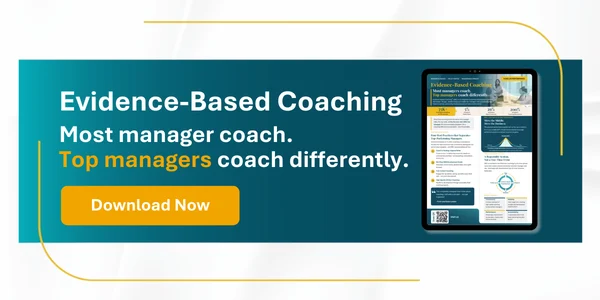
Download the Evidence-Based Coaching overview to see how Echelon helps pharmaceutical and life sciences organizations turn manager coaching into a repeatable driver of field performance.